The Challenge
Tracker selection used to be judged mostly on energy yield. On sites with variable topography, it is increasingly judged on earthworks volume, terrain adaptation, and total CAPEX as well. Earthwork is one of the largest and least predictable line items in utility-scale construction, and a layout that fights the terrain can move thousands of cubic metres of soil before a single module is installed.
This study isolates one question: holding everything else fixed, how much does the tracker architecture alone change earthwork volume on a difficult site?
The Comparison Setup
To keep the comparison technically honest, the same digital terrain model, the same site boundaries, the same layout criteria, and the same project assumptions were used for both designs. The only parameter that changed was the construction system: a Single Row Tracker (SRT) in one scenario and a Terrain Following Tracker (TFT) in the other. Both scenarios were generated and measured on a single data model in PVX.Cad, so the two cut and fill figures are directly comparable rather than two separate studies stitched together.
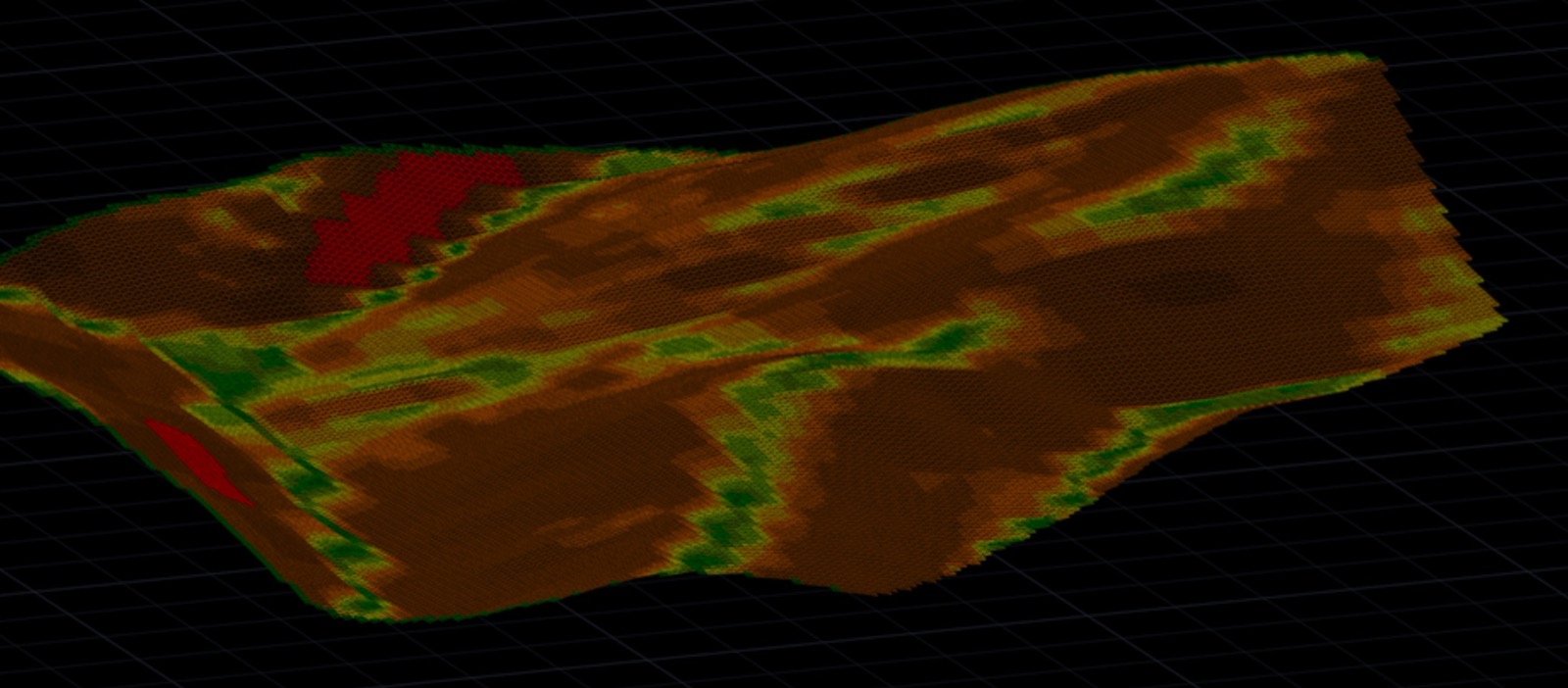 The existing terrain, slope-classified in PVX.Cad. The same surface feeds both tracker scenarios.
Single Row Tracker
A Single Row Tracker holds long, continuous rows on a near-single plane. Where the slope changes along a row, the design surface has to pull away from the existing ground, and the gap between them is filled with cut and fill. On gentle terrain this is minor. On a site with rolling or broken topography it compounds quickly, because every row has to reconcile its length with the ground beneath it.
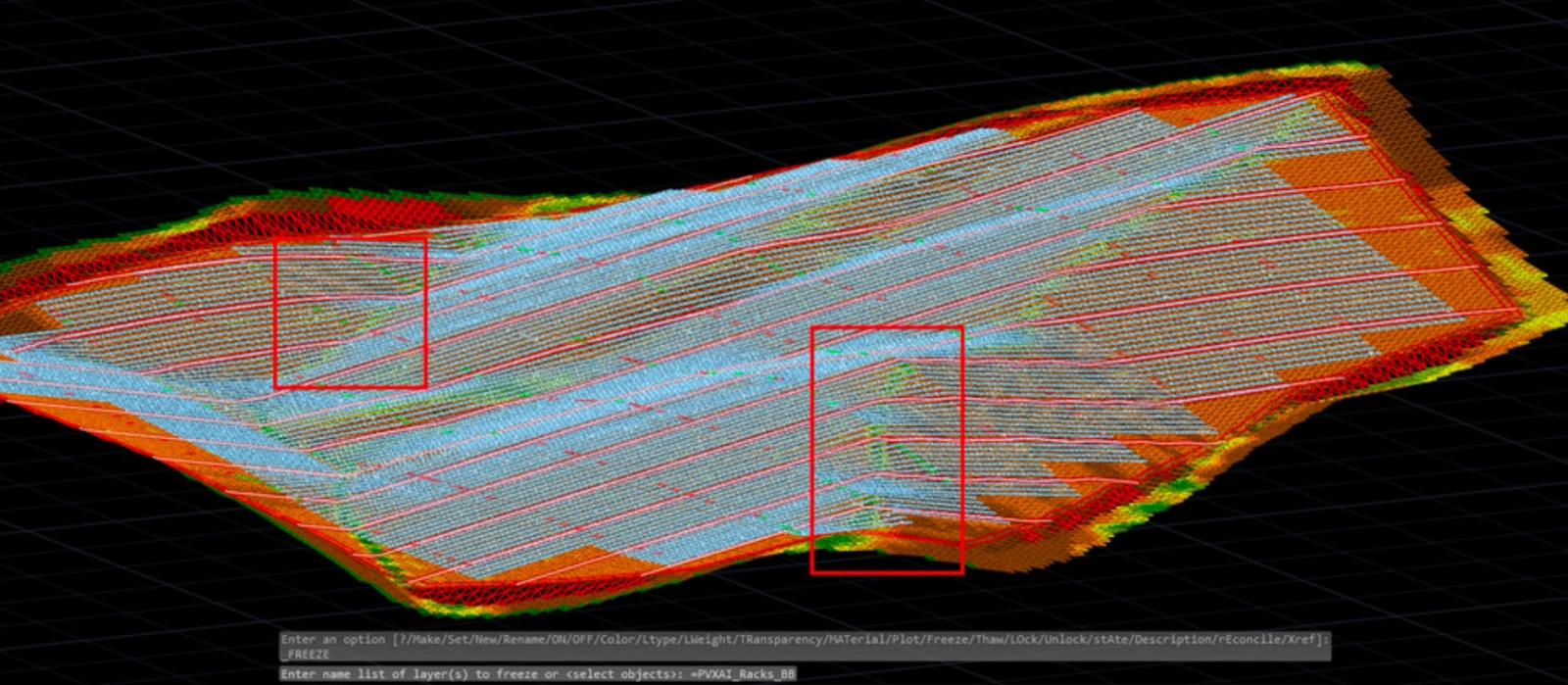 Single Row Tracker. The red boxes mark where continuous rows force the most cut and fill as the slope changes.
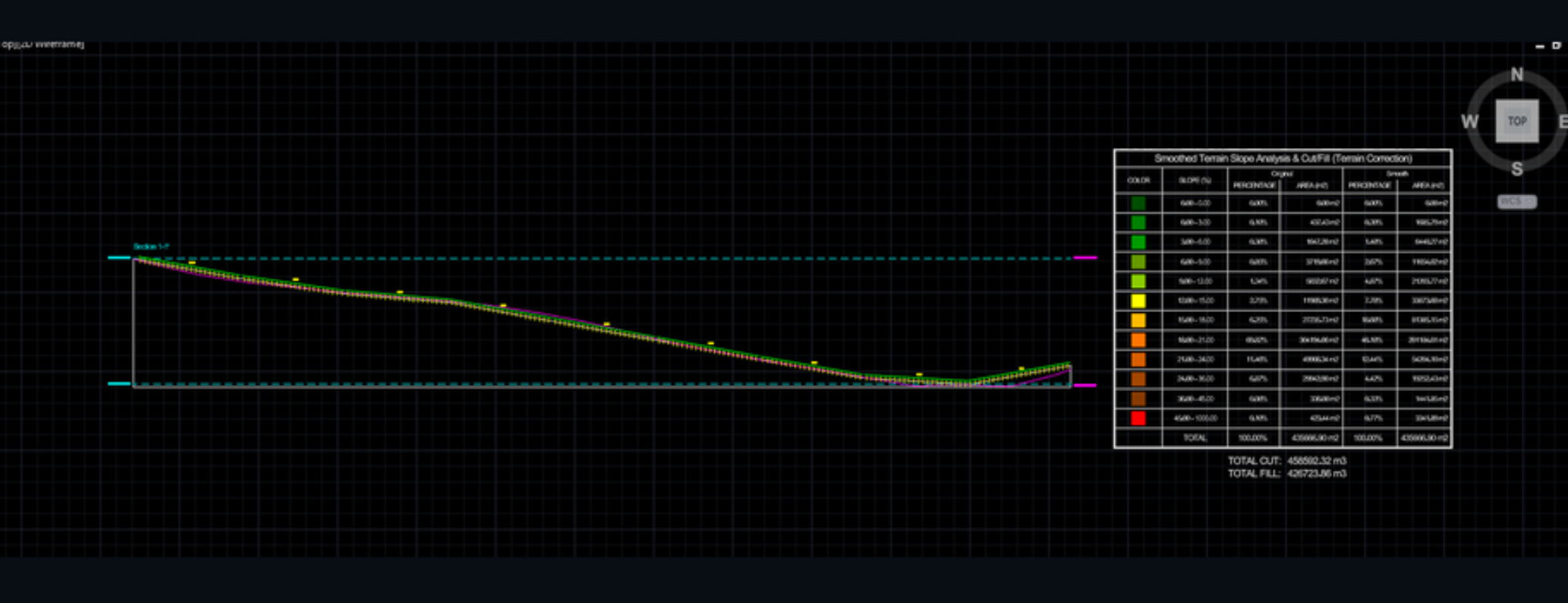 Section PV-1. The vertical gap between the design profile and the existing ground is where excavation volume accumulates.
In section view PV-1, the Single Row scenario required a total cut of 458,592 m³ against a total fill of 426,724 m³.
Terrain Following Tracker
A Terrain Following Tracker is engineered to conform to the north-south undulations of the ground instead of holding one continuous plane. Because the design surface stays close to the existing terrain, the vertical gap that drives cut and fill collapses across the same site. The layout still has to respect the project criteria, but it no longer pays an earthwork penalty for forcing the ground to match the racks.
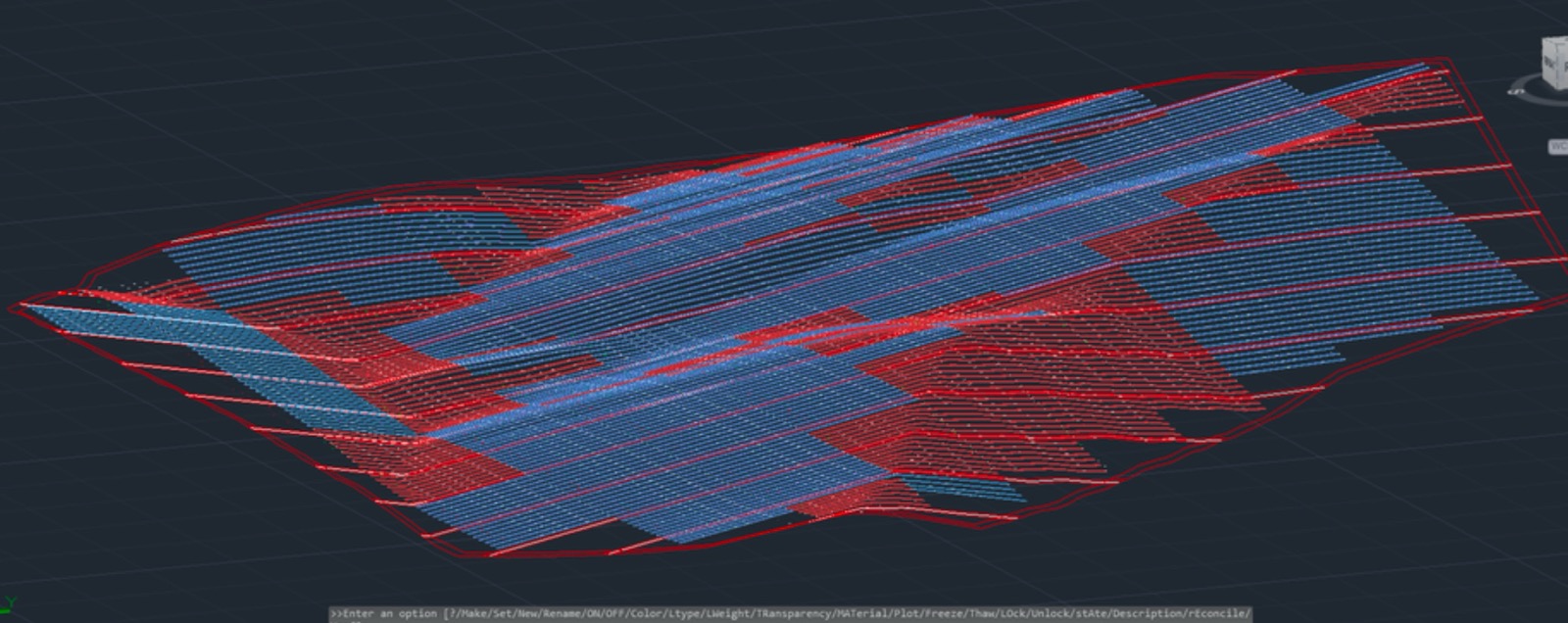 Terrain Following Tracker. The array follows the natural contours, so the design surface stays near the existing ground.
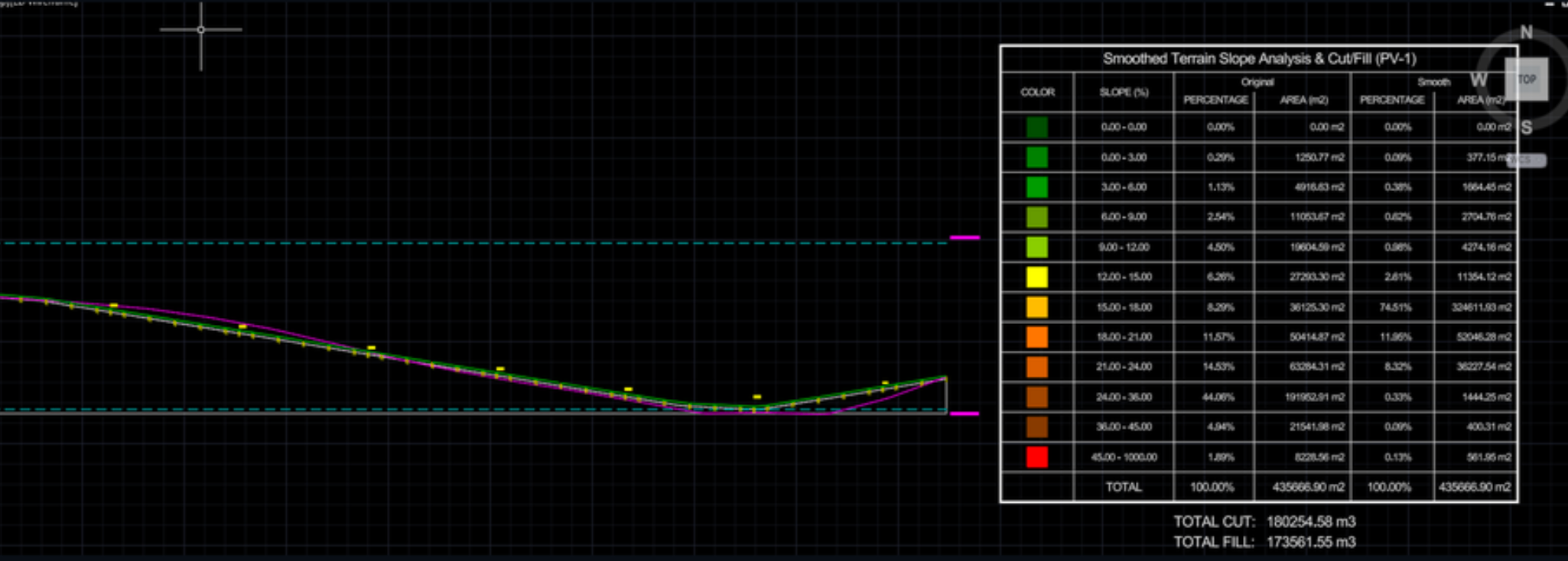 Section PV-1, same location. The design line now tracks the ground closely, collapsing the cut and fill volume.
In the same section PV-1, the Terrain Following scenario required a total cut of 180,254 m³ against a total fill of 173,562 m³.
Side by Side
| Scenario | Total cut (m³) | Total fill (m³) |
|---|---|---|
| Single Row Tracker | 458,592 | 426,724 |
| Terrain Following Tracker | 180,254 | 173,562 |
| Difference | −278,338 (−60%) | −253,162 |
On the same site, under the same criteria, the Terrain Following Tracker moved about 278,000 m³ less soil in cut alone, roughly 60% less excavation.
Key Findings
- Cut volume fell about 60% on the same site, from 458,592 m³ to 180,254 m³, by changing only the tracker architecture.
- Everything else was held constant. Same topography, boundaries, layout criteria, and project assumptions, so the delta is attributable to the construction system, not the site.
- The section view, not the plan view, reveals the cost. Earthwork volume grows with the vertical gap between the design profile and the existing ground, which only a section makes visible.
- The result is site-dependent. It will not repeat on every project. The gain is largest on variable topography and marginal on flat ground.
- Earthwork is a CAPEX lever, not a detail. On difficult terrain, a difference at this scale can move total project cost, which is why tracker architecture now belongs in the earthworks conversation.
- Both scenarios were generated and compared on one data model in PVX.Cad, so the two figures are measured the same way and are directly comparable.